Persistent Features in Slots: How Progress Is Saved Between Spins
Persistent features have changed the way some modern slots handle progression. Instead of treating every spin as a completely isolated visual experience, these games can retain selected information such as collected symbols, filled meters, unlocked Wild types or feature levels. Depending on the design, that progress may remain active for several spins, for the duration of a bonus round or even after the player closes the game and returns during another session. By 2026, this approach is used by several established slot developers, but the term “persistent” is not applied consistently across the industry. A sticky Wild that lasts until a bonus ends and a collection meter saved for several days are both sometimes described as persistent, even though they work very differently. Understanding that distinction is important because saved progress does not automatically mean better odds, a guaranteed bonus or a win that is becoming “due”. It simply means that a defined part of the game state can continue instead of resetting immediately.
What Persistent Features Actually Do in Modern Slots
At its simplest, a persistent feature remembers something that happened during earlier play and allows that information to affect the visible state of later spins. A slot might count particular symbols, fill sections of a meter, upgrade a character, open new Wild variations or retain an accumulated feature level. Instead of returning every element of the interface to its starting position after each spin, the game keeps the designated progression element active according to its published rules. The next spin is therefore presented within a state partly shaped by what has already been collected. This creates continuity without necessarily changing the basic process that determines the outcome of an individual spin.
Collection meters are among the easiest examples to understand. A specific symbol may add one or several points to a meter whenever it appears. After reaching certain stages, the meter can unlock a stronger feature, add another possible modifier or make a particular bonus event available. Some games establish a fixed threshold, while others use stages where reaching the final level merely creates a chance of activating the related feature. Those designs should not be treated as equivalent. If a rule says that collecting a certain number of objects guarantees an unlock, the progression has a defined target. If it says that an object “may” trigger a feature after a particular stage is reached, the final activation still depends on a random event.
There is also an important difference between persistence across consecutive events and persistence across separate sessions. A multiplier that survives several cascades within one paid spin is persistent only within that sequence. Sticky Wilds that remain throughout ten Free Spins are persistent within the bonus. By contrast, a meter that still shows the same collected total after a player closes the game and later returns represents session-to-session persistence. Current slot releases use all three models. For that reason, players should read the game information rather than assuming that the word “persistent” always means that progress will still be present after logging out or changing device.
What Is Stored and What Normally Resets
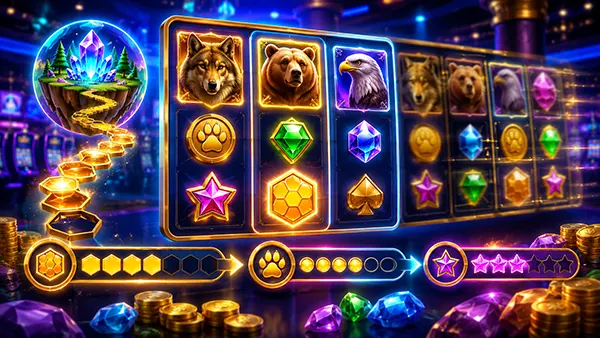
Longer-term persistent systems generally save clearly defined progress variables rather than the complete history of play. Typical examples include the number of collected objects, the current stage of a progression meter or a group of features that have already been unlocked. Play’n GO’s 2026 Wild North Radiant Skies GO Collect illustrates this structure clearly: footprints appearing on selected animal symbols are collected and stored, moving the player through four stages of progression across sessions. The saved element is the accumulated trail and its current stage. Individual reel results, previous winning combinations and ordinary symbols are not carried forward in the same way.
Other games use persistence to unlock additional behaviour rather than simply filling a single bar. Crabby’s Gold, released by Play’n GO in 2025 and still a useful example of this design in 2026, has a Rum Barrel Meter that develops over time. Collecting bottles advances the Wild system through several stages, giving access to Multiplier, Expanding, Sticky, Walking and eventually Mega 2×2 Wilds. The important point is that the persistent element is the progression of the Wild system. It should not be confused with a promise that one of those Wilds must appear on the next spin or that a particular payout is waiting to be released.
Players should also avoid assuming that everything visible beside the reels is automatically saved. A temporary multiplier, a number of remaining Free Spins, symbols held during a Hold’n Spin round or a meter tied to a single cascade sequence can reset as soon as that defined round ends. The precise behaviour depends on the individual game rules. Long-term progress may also be associated with the player’s account and the particular version of the game supplied by an operator. If persistent progress is an important part of a title, the safest approach is to check its help section for wording such as “saved across sessions”, “persistent progress”, “does not reset” or a specific explanation of when the meter returns to its initial state.
Real Persistent Mechanics Seen in Slots in 2026
Play’n GO made session-to-session progression especially visible in several recent releases. Wild North Radiant Skies GO Collect, released in March 2026, places footprint overlays on high-value animal symbols. Those footprints are gathered instead of disappearing permanently after the relevant spin, and the accumulated progress moves through four stages. New footprints can also provide access to the Northern Lights Wheel, which selects one of five animal-related trials. The important feature from a persistence perspective is not the Wheel itself but the stored footprint progression behind it. A player returning later can therefore continue from an existing stage rather than automatically beginning again from zero.
Another current example is Holy Moo! Extreme Power, released on 6 August 2026. The game uses a 6×6 cluster layout and marks positions with persistent frames during its cascading sequences, but it also contains a broader Collector Path progression system. Collector appearances advance this path and unlock additional Collector variants with different behaviours over time. This shows why the word “persistent” needs context: the persistent frames belong to one part of the immediate gameplay, whereas the Collector Path provides progression that develops across sessions. Two persistent concepts can therefore exist in the same title while operating over very different time periods.
Persistent progression was already established before these 2026 releases. Piggy Heist from Play’n GO uses a Stethoscope Wild Meter that develops across sessions and gradually opens several Wild types, with the developer stating that the meter does not reset. Push Gaming’s Wild Swarm series uses a different presentation based on collecting bees and developing a Hive. The original Wild Swarm saves progression between sessions, while Wild Swarm 2 expands the idea through a five-level Hive meter. Worker Bees add one segment and Queen Bees add five. Once level five has been reached, a subsequent Bee Symbol can trigger Swarm Mode, with the Queen Bee carrying a higher chance of doing so. Reaching the advanced state therefore matters to the feature rules, but it should not be interpreted as an immediate guaranteed trigger.
Progress Meters, Unlocks and Persistent Symbols
Collection meters create the clearest sense of long-term progress because the player can usually see what has already been accumulated. The underlying object can be almost anything that fits the theme: bees, footprints, bottles, coins or character-related items. What matters mechanically is that qualifying events add to a stored counter. A well-explained meter should show what advances it, which stages exist and what happens after each stage is reached. The meter may unlock new possibilities, change the set of modifiers that can appear or eventually lead to a separate bonus. This visible structure gives repeated sessions continuity, but the collection itself is not necessarily a monetary balance and should not be treated like money already won.
Unlock systems take the idea a step further by changing what the game is capable of doing after enough progress has been recorded. Crabby’s Gold illustrates this with its succession of Wild types, while Piggy Heist builds towards expanding, sticky, walking and Mega Wild functionality. Holy Moo! Extreme Power uses Collector Path development to introduce different Collector behaviours. In each case, persistence works as a progression layer placed around the normal slot cycle. Earlier activity can determine which feature variants have become available, yet the actual appearance and result of those features still follow the game’s stated rules. An unlocked modifier is therefore an available mechanic, not a stored payout.
Persistent symbols are often more temporary. A Sticky Wild may remain in one position until Free Spins end, a multiplier may survive through a chain of cascades, or a coin may stay fixed for the duration of a Hold’n Spin feature. Relax Gaming’s 2026 Treasure Tumble, for example, uses persistent multipliers in its Super Galleon Bonus. That is genuine persistence within the bonus, but it is not the same as an account-level progression meter retained for future sessions. This distinction helps prevent misleading comparisons between games. When assessing a feature, the useful question is not simply whether it is persistent, but exactly what persists and for how long.

What Persistent Progress Means for RTP, Odds and Player Decisions
Saved progress can make a slot look as though it is moving towards an important event, but this does not mean ordinary random outcomes have stopped being random. In regulated markets such as Great Britain, technical rules require random number generation and game results to be acceptably random and prohibit adaptive behaviour that changes outcome probabilities during play merely in response to previous results. Bonus and special features can use their own published rules, including rules affected by collected progress, but those changes form part of the defined game model. A meter being nearly full therefore should not be interpreted as evidence that an unrelated large win is statistically overdue.
RTP also needs to be separated from the visual progress shown on the screen. Return to Player is a theoretical long-term percentage based on the mathematical configuration of a game, not a prediction of what one individual session will return. Some developers provide several RTP configurations for the same slot, and Push Gaming, for example, states on its game pages that RTP can vary by casino. A persistent feature may be built into the mathematical model, but the presence of stored progress does not by itself reveal the value of the next spin. Two players who see different stages of a feature meter may have access to different feature states, yet this does not justify assuming a specific short-term return unless the game rules provide enough information to calculate it.
This matters because persistent design can create a strong sense of unfinished business. A meter at four stages out of five can feel more valuable than an empty one, and walking away may feel like abandoning progress already earned. From a practical bankroll perspective, however, previous stakes have already been spent. Continuing solely because a meter appears close to completion can lead to additional spending without any certainty that the eventual feature will return the extra amount used to reach it. Persistent progress is best treated as part of the entertainment structure of a slot, not as a reason to exceed a spending or time limit established before play.
How to Read Persistent Features Before Playing
The first detail to check is the exact trigger condition. A progress system can have a guaranteed threshold, a chance-based threshold or several intermediate stages. Wild Swarm 2 provides a useful illustration: Worker and Queen Bees advance the Hive, but after level five is reached, a Bee Symbol may trigger the Swarm Mode rather than the meter simply paying the feature the moment it reaches that level. Wording such as “may trigger”, “chance to activate” or “can unlock” matters. A player who assumes that every full meter guarantees an immediate bonus can form a very different expectation from the one described by the actual rules.
The second point is the reset policy. Check whether progress lasts only until the current paid spin ends, until a bonus finishes, during one uninterrupted session or across later sessions. For true long-term persistence, it is also sensible to check whether the saved state depends on remaining logged into the same account, using the same version of the game or returning through the same casino site. Suppliers do not always publish every technical detail of how progression data is stored, and implementation can differ between operators and regulated markets. The game information screen is therefore more reliable than assuming that progress seen in one version will automatically transfer to another.
Finally, persistent features should be compared on clarity rather than on how strongly they create a feeling of being close to a reward. A useful design tells the player what is collected, which stages have already been reached, what each unlock changes and what conditions can reset the progress. In 2026, titles such as Wild North Radiant Skies GO Collect, Holy Moo! Extreme Power, Crabby’s Gold, Piggy Heist and Wild Swarm show several different ways developers can retain selected progress. None of these systems changes the basic need to read the rules, check the available RTP configuration and manage spending independently of the state of a meter. Persistent progression can provide continuity between spins or sessions, but it should not be mistaken for a method of predicting the next random result.